Category: Campaigns

  • Statement on Bill C-4 and Digital Privacy

    Bill C-4, a federal bill named “An Act respecting certain affordability measures for Canadians and another measure”, silently included a measure weakening privacy laws. The “[other]  measure” would explicitly legislate that provincial and territorial privacy laws not apply to federal political parties and third-party services they employ. The bill provides for each party to create and publish its own privacy policy. It does not include a sufficiently robust federal regime to oversee this new change. This self-serving provision is dangerous as it undermines democratic processes, punishes grassroots movements that lack the digital firepower to rival their counterparts, and erodes privacy regulation in Canada.

    This is an unwelcome setback in privacy policy. It provides a pathway for political campaign services to further merge with political parties. As each party is now responsible for its privacy policy, applications will have increased leverage with sensitive private information from party databases and vice versa. With this growing market, this unholy alliance between surveillance and politics will grow and pose a great threat to democracy. Campaign expenditures can be used to delegate privacy policies to third-party applications who can skirt enforcement as they hide behind their association with political parties. When local communities push back against privacy violations, they will no longer have their own local laws as a recourse.

    Technologists for Democracy strongly condemns this provision, along with how it was silently added into a bill that has nothing to do with privacy. Democratic integrity is at stake and no one has asked for this.
  • Stop Cineplex from Facial Detection

    November 2025 — Now

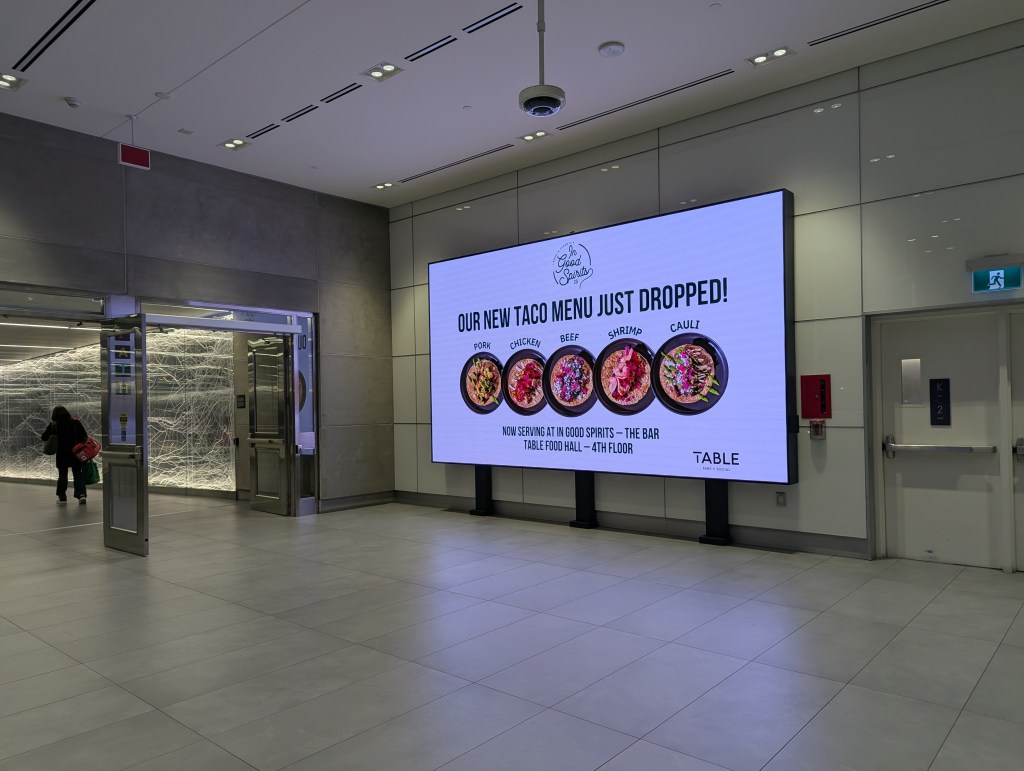
    TL;DR: Cineplex Digital Media (CDM) makes digital billboards with cameras performing facial detection.

    One of the digital billboards that are performing facial detection at Union Station Bus Terminal.

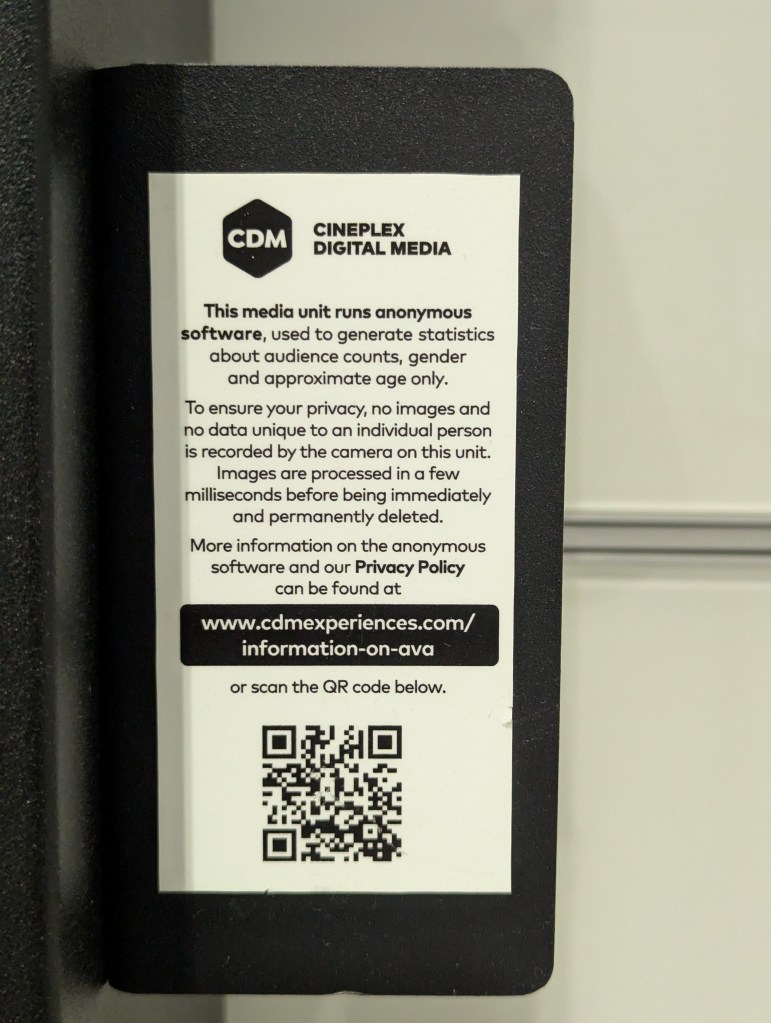
    In early November, a Redditor discovered that ads at Union Station Bus Terminal have tiny cameras attached. The small privacy notice on the ads indicated that they run “anonymous software” to “generate statistics about audience counts, gender and approximate age”. Visiting their website tells us that they perform facial detection on anyone nearby!

    The privacy notice in question.

    CDM Cineplex Digital Media

    This media unit runs anonymous software, used to generate statistics about audience counts, gender and approximate age only.

    To ensure your privacy, no images and no data unique to an individual person is recorded by the camera in this unit. Images are processed in a few milliseconds before being immediately and permanently deleted.

    More information on the anonymous software and our Privacy Policy can be found at

    www.cdmexperiences.com/information-on-ava

    or scan the QR code below.

    News agencies quickly covered the issue, with articles coming out at Now Toronto, the Toronto Star, CTV News and Global News.

    Close up of the camera on top of the billboard.

    Volunteers at TfD have written an open letter to CDM. Organizations including OpenMedia, TTCriders and More Transit Southern Ontario have signed on, calling for CDM to answer our privacy concerns.

  • Stop Bill C-2 from Surveilling Us

    Bill C-2 was first introduced in May as an omnibus bill. It has faced criticism by multiple organizations:

    Many organizations have also criticized other aspects of the bill:

    There are a number of concerns that we as technologists have with regards to Bill C-2:

    1. Loss of privacy from requiring electronic service providers to provide basic subscriber information to CSIS and law enforcement agencies without a warrant.
      • Creation of a new term, electronic service provider, which includes social media platforms, email providers, messaging services, gaming platforms, internet service providers, and more…
    2. Reduction of oversight over CSIS and law enforcement agencies.

    Take action now to stop Bill C-2!

  • Tell Magna to Stop Recording our Faces

    June 2025 — October 2025

    Update 10/02/25: Magna is no longer operating its pilot in Toronto! Thank you to everyone for your support in making this happen. Innovation does not need to come at the cost of privacy!

    Our original post is below.


    On May 26, 2025, Magna International Inc. began a self-driving vehicle pilot for food delivery within the City of Toronto. Magna intends to blur license plates but record people’s faces within the vicinity of the vehicle because “Magna believes that faces are very useful to determine gaze, pose and intent of motion” according to a background report by the City.

    Other companies like Real Life Robotics, which is running a self-driving vehicle pilot in Markham, aren’t recording people’s faces: “the AI software [Real Life Robotics] use can easily scrub identifying features, like faces and licence plates.”

    How you can help!

    On June 27, we sent a letter (read here) to Magna with a list of specific privacy concerns based on their privacy policy.

    If you want to get involved with strategy and planning, sign up on our volunteer page!

    More info

    A view of Magna's delivery vehicle from the back. The vehicle is smaller than a car and has three wheels.
    Magna’s last-mile delivery device (LMDD) operating in Michigan.

    On June 11, 2025, the pilot was discussed at the City of Toronto’s Infrastructure and Environment committee. The pilot is under the jurisdiction of the Province of Ontario, but Toronto is allowed to submit comments and feedback to the Province.

    JJ, Ilya, Khasir and Akhil spoke up about the privacy concerns surrounding the pilot. Thanks to their voices, city councillors passed a motion on June 26 to investigate data privacy issues through the following questions:

    1. What type of data is being collected?
    2. Who has access to this data?
    3. Where is this data being stored?
    4. Can or will this data cross the border into the United States?
    5. Can Magna entities within the United States view the data?
    6. Would Magna entities be required to provide data to US or Canadian law enforcement if requested?
    7. Will facial recognition data be shared with law enforcement?
    8. Can future agreements change the nature of how the data is collected, stored, transmitted, and used?
    9. Are there any mechanisms for individuals, including those who cannot provide consent, such as children, to opt-out or request that their records be deleted?
    10. Are there ways to ensure that data can be destroyed if no consent was given?
    11. Can the terms and conditions of data management be changed, and if so, by whom?
    12. Does the City’s Digital Infrastructure Strategic Framework govern the collection and use of this data and if not, what can the City do when third parties want to harvest data in the public realm?