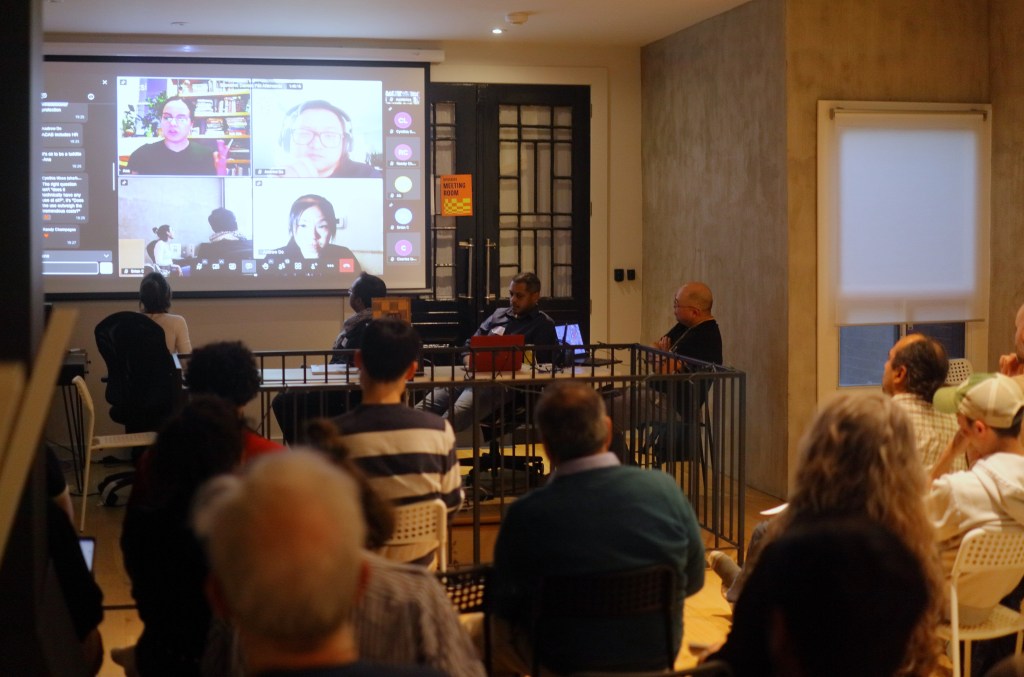
We asked the participants to grapple with what their demands are for how the Government of Canada can reconsider their National AI Strategy.
Co-develop regulations with communities: Currently, AI is developed and concentrated among a small number of market players that are built for a global optimum at the expense of optimizing for local community needs. There is an opportunity to have more local community input to shape rules on how this technology is produced and deployed.
Develop AI as publicly-owned infrastructure: Much in the way that utilities are often publicly-owned, we can institutionally entrench AI as a public good by having publicly-owned AI that is democratically controlled.
Ban AI from being deployed for surveillance: There are serious concerns with how AI can be used to surveil workers in the workplace and across society in general. With privacy being critical, the people demand that AI not be used for surveillance purposes.
Stronger labour protections for workers: There are many workers who will be impacted by this technology. The people believe that any claims of productivity gains will accrue to investors at the expense of workers. The people support the idea of a bill of rights for specific workers involved in the production of AI, such as data workers. The people also support collective bargaining agreements that would govern the use of AI in the workplace.
Regulatory bodies must protect themselves from regulatory capture by big tech: With the far-reaching impacts AI has had, the people demand that AI be regulated. Such demands include: monitoring how AI is deployed, requiring safety audits of AI models, and co-developing a bill of AI safety directly with communities. It is critical that workers and representatives from the community be directly involved in the governance of these bodies, and that they do not become captured by industry.
Enforce existing laws: There are many existing laws that are not being enforced that enable the proliferation of AI, such as privacy legislation, intellectual property legislation and competition legislation. The people demand that these existing laws be enforced.
Dear Chief Privacy Officer at Cineplex Digital Media:
We are writing to you with regards to privacy concerns surrounding your usage of Anonymous Video Analytics (AVA) in digital signage near Union Station Bus Terminal (USBT) and elsewhere in Canada. We represent both technologists and regular Canadians who see the value in innovation and technological development for public good.
In 2020, the Office of the Privacy Commissioner of Canada (OPC), as well as the privacy commissioners for Alberta and British Columbia, released a report on a case involving use of AVA technology by Cadillac Fairview (CF) in 2018.1 The report found that CF’s AVA deployment constituted a violation of privacy, and that “express opt-in consent would be required, as they determined that some of the information involved was sensitive and its surreptitious collection in this context would be outside the reasonable expectations of consumers.”2
We have a number of concerns relating to the aforementioned report and would like some clarifications.
Concern 1: How has the joint investigation conducted in 2020 by the Offices of the Privacy Commissioner of Canada, Alberta and British Columbia affected CDM’s deployment of AVA technology?
Concern 2: A Toronto Star article by Kevin Jiang also mentions that CDM has consulted with the OPC for this project.3 How has this consultation mitigated some of the privacy issues that have arisen in the use of AVA?
We also have concerns with certain statements in the privacy notice affixed to AVA-enabled digital signage by Cineplex (CDM).4
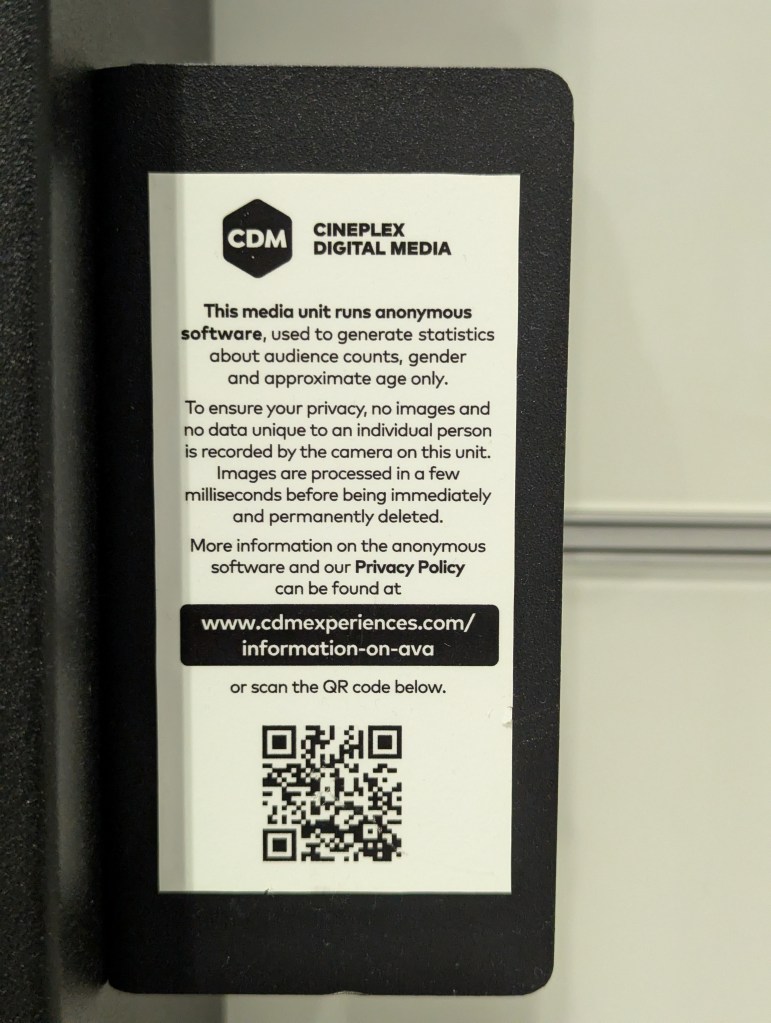
Statement 1:This media unit runs anonymous software, used to generate statistics about audience counts, gender and approximate age only.
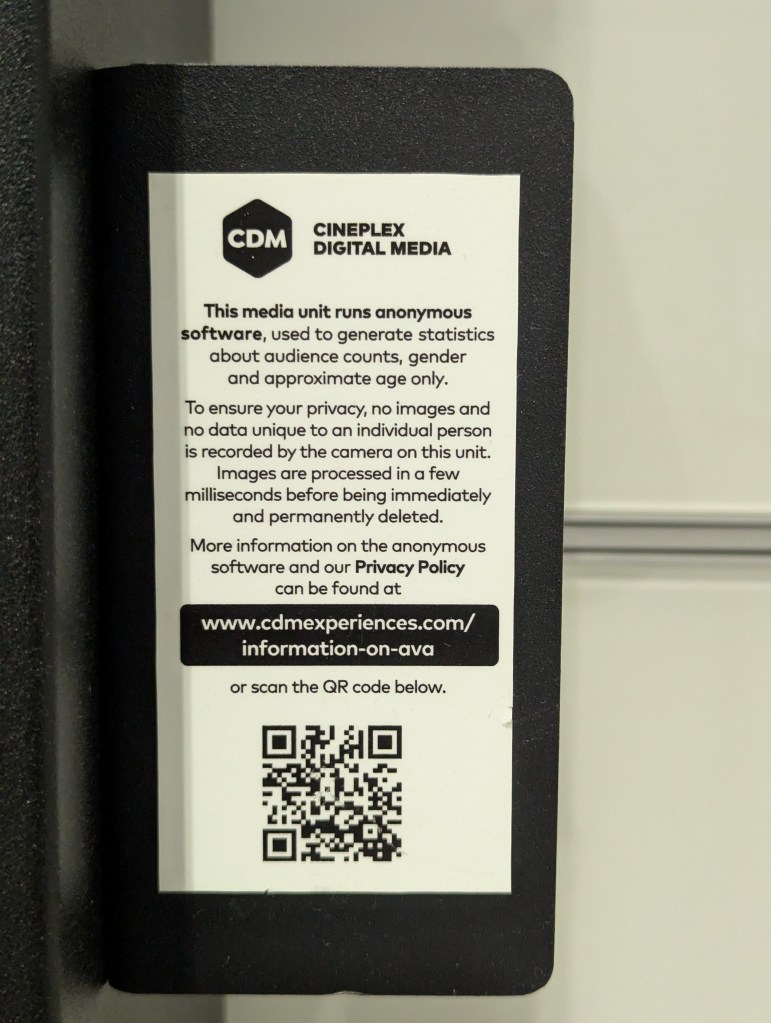
Concern 3: What is the intended meaning of the phrase “anonymous software” per Statement 1 (also see Figure 1 in the Appendix)?
Statement 2:Images are processed in a few milliseconds before being immediately and permanently deleted.
Concern 4: If images are processed in the matter of milliseconds before being permanently deleted, this implies that images are only processed on-device, as opposed to being sent to a remote server or cloud service. Are images processed on-device?
Concern 5: Is any personally identifying information or biometric data collected, inferred, extracted or stored beyond statistics on audience counts, gender and approximate age?
Concern 6: Does the data collected by AVA reside in Canada?
Concern 7: What measures are in place to protect data privacy during transfer and storage of data in remote servers or cloud facilities?
We also have a number of concerns with certain statements in your notice of disclosure:5
Statement 3:We ensure that the public is well informed as [sic] the presence of anonymous video analytics systems by placing signage and stickers on kiosks, at property entrance, exit ways and other places along the path to the property.
Concern 8: Upon an investigation of Union Station Bus Terminal in early November 2025 by members of Technologists for Democracy, no warning of AVA systems was found except those attached to display signage themselves. This runs contrary to the above statement.
Statement 4: Camera sensors are installed in plain sight and are never hidden. We want the public to understand exactly where they are placed so, if they chose, they can avoid it.
Concern 9: Cameras attached to Cineplex’s digital signage are visible but quite small and difficult to identify. Over 90% of the general public interviewed by members of Technologists for Democracy were not previously aware of cameras attached to said signage. Areas where the digital ads are currently placed adjacent to USBT are unavoidable for individuals passing by in hallways coming from Union Station (i.e., two digital ads are placed very close to a train timetable, while the other is facing an entrance to USBT itself). This and concern 8 run contrary to the statements that cameras are “in plain sight”, “never hidden” and “if they [the public] chose, they can avoid it.”
We also have a number of concerns with certain statements in your privacy policy:6
Statement 5: Other Uses: We may also use Personal Information, where necessary, for: establishing, maintaining and/or fulfilling relationships with our business partners, third-party vendors of products and/or services, as well as our corporate and business customers;
Concern 10: Are images of individuals sold to any third parties?
Concern 11: Are statistics on audience counts, gender and approximate age sold to any third parties?
Concern 12: Are any other data collected by AVA sold to third parties?
Statement 6: Cineplex may also share Personal Information necessary to meet legal, audit, regulatory, insurance, security or other similar requirements. For instance, Cineplex may be compelled to disclose Personal Information in response to a law, regulation, court order, subpoena, valid demand, search warrant, government investigation or other legally valid request or enquiry. We may also share information with our accountants, auditors, agents and lawyers in connection with the enforcement or protection of our legal rights.
Concern 13: If data collected by AVA systems or digital signage is requested and sent to third parties for legally valid requests or enquiries, is there a mechanism for informing the public?
Concern 14: If data collected by AVA systems or digital signage is requested and sent to third parties for legally valid requests or enquiries, is there a mechanism for third-party audits of such data requests or enquiries?
Concern 15: It has been reported that CDM is being sold to US-based Creative Realities,7 who will take over ad billboards spanning malls and office buildings. Per this deal, will Creative Realities also take ownership of AVA systems?
We request that Cineplex Digital Media provide clarity on:
How you are ensuring that individuals captured by AVA systems remain anonymous.
How you are ensuring individuals are properly informed of recording and facial detection performed on premises.
Your data policy and transparency around sharing of information to third parties.
How your AVA system differs from Cadillac Fairview’s AVA system involved in the joint investigation conducted in 2020 by the Offices of the Privacy Commissioner of Canada, Alberta and British Columbia.
Innovation does not have to come at the cost of personal privacy. We are concerned with the lack of clarity surrounding the privacy notice and the privacy statements in CDM’s website. We are also alarmed at the prospect of a foreign company taking over CDM’s ad billboards to service software that may operate outside of Canadian laws and regulations.
We would greatly appreciate a response within 10 business days. Please reply to this email or reach out directly to Khasir Hean at khasir.hean@gmail.com / 226-927-2677 if you have any questions or would like to discuss details further.
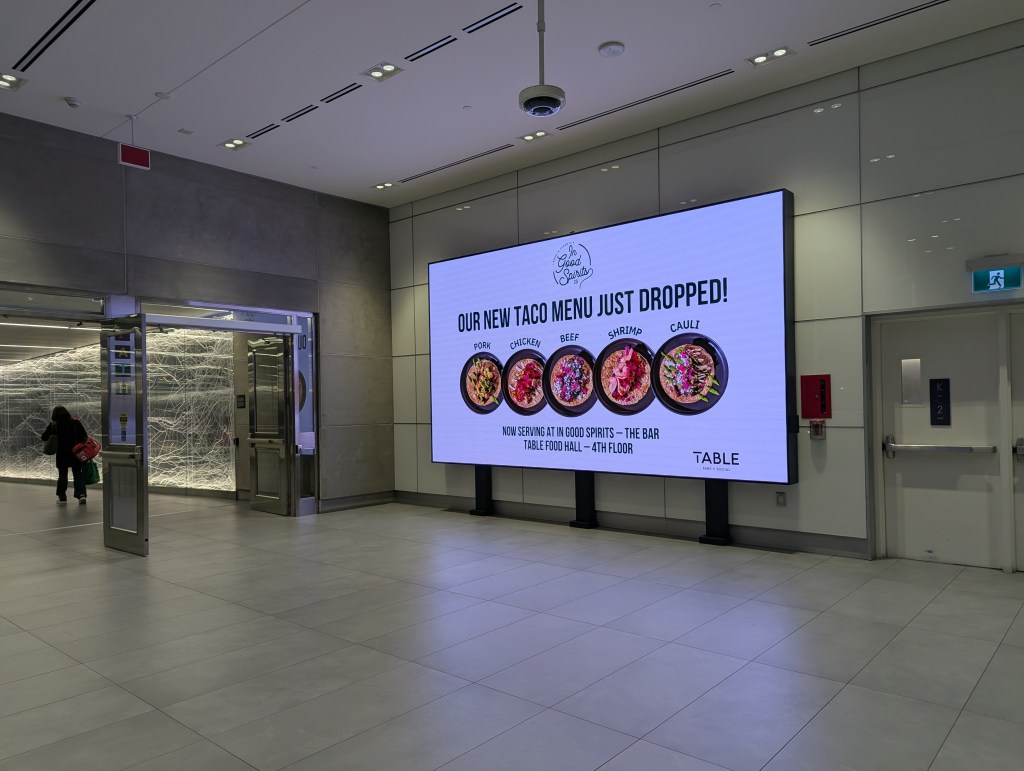
One of the digital billboards that are performing facial detection at Union Station Bus Terminal.
In early November, a Redditor discovered that ads at Union Station Bus Terminal have tiny cameras attached. The small privacy notice on the ads indicated that they run “anonymous software” to “generate statistics about audience counts, gender and approximate age”. Visiting their website tells us that they perform facial detection on anyone nearby!
The privacy notice in question.
CDM Cineplex Digital Media
This media unit runs anonymous software, used to generate statistics about audience counts, gender and approximate age only.
To ensure your privacy, no images and no data unique to an individual person is recorded by the camera in this unit. Images are processed in a few milliseconds before being immediately and permanently deleted.
More information on the anonymous software and our Privacy Policy can be found at
Volunteers at TfD have written an open letter to CDM. Organizations including OpenMedia, TTCriders and More Transit Southern Ontario have signed on, calling for CDM to answer our privacy concerns.
Re: Help define the next chapter of Canada’s AI leadership
National AI Strategy Consultation Needs Wider Variety of Perspectives
Dear members of the Canada AI Strategy Task Force:
We are Technologists for Democracy, a grassroots advocacy organization based in Toronto.
We appreciate Innovation, Science and Economic Development Canada’s vision to renew national AI strategy. However — considering the impact that such a strategy will have on various aspects of public life, democratic values, and individual rights — we maintain that public participation is not just a nice-to-have, but a democratic and practical necessity. We strongly urge that something as wide-reaching and important as a national AI strategy not be formulated in a sprint as short as a month.
Such a strategy requires a more thoughtful and detailed approach. Expediting the process leads to a higher risk of unforeseen public harm, wasted resources, and loss of public trust. We urge ISED to consider extending the deadline to allow for a wider variety of perspectives and responses from the public.
We also observe that the current consultation on national AI strategy is highly biased towards an economic perspective, which puts the public at risk of exploitation by industry partners. We understand that ISED’s mandate focuses on economic development and trade; however, national AI strategy must take into consideration a variety of perspectives.
If Canada wants to compete on the global stage for AI talent, we should lean into our strengths: diversity, inclusivity, and prudence. It is difficult to compete with the level of investment that investors in the United States offer towards AI firms located primarily in Silicon Valley. We must compete in other ways.
Investors and entrepreneurs alike are aware of Canada’s risk-averse nature surrounding capital expenditure. This is not something to be ashamed of — Canada escaped from the worst effects of the 2008 financial crisis due in large part to caution and regulation surrounding financial institutions.
Considerations must also be made with the possibility in mind that AI investments have created a bubble. Both in terms of a technical bubble, where technology does not function well enough to deliver the value claimed, and an economic bubble, where investors lose faith in AI companies and pull capital as investing becomes unsustainable. Mitigation strategies should evaluate the value of physical AI infrastructure, such as data centers, in case of bubble collapse.
KPIs should not emphasize adoption of AI purely for its own sake. Canada should focus on providing resources towards education of how various forms of AI can aid business processes, with special attention towards how AI can be deployed fairly and ethically. We believe measures should focus on:
Adoption and implementation of strong governance frameworks which minimize potential harm of AI systems, and ensure fair and transparent outcomes.
Employment creation by AI, rather than workforce reduction.
Creation of mechanisms for continuous feedback to guide improvements and provide targeted training opportunities.
AI should not be forced onto society only for the economic benefits that it may bring. AI should serve and augment society, elevating those who would otherwise be invisible, and contributing to a fairer and more inclusive Canada. It is important to keep humans in the loop in such a way that we humans get the most out of machines, as opposed to machines making the most out of humans.
We reiterate that national AI strategy must:
Be made in consultation with a wider variety of perspectives.
Not be exclusively focused on the economic implications of AI.
Take into consideration the possibility of an AI bubble bursting.
Focus on fair, ethical and transparent AI governance frameworks.
Now is the pivotal time to build an AI strategy that serves all Canadians.
September 25, 2025 (Toronto, ON) – Technologists for Democracy is a grassroots, volunteer-run advocacy organization. We are disappointed by Premier Ford’s decision to ban automated speed enforcement (ASE) cameras. The Hospital for Sick Children and Toronto Metropolitan University have found that ASE cameras in Toronto reduce the proportion of people speeding by 45%, and reduced motor vehicle speeds by 7km/h overall.1
Reducing motor vehicle speeds is proven to improve safety. When the City of Toronto reduced speed limits from 40km/h to 30km/h, collisions decreased by 28%, and major and minor injuries decreased by 67%.2 Additionally, 73% of Ontarians support ASE cameras in targeted zones.3
These facts point to the importance and popular support for enforcing speed limits and reducing motor vehicle speeds. We call on the Province of Ontario to commit to public safety by ensuring that drivers obey posted speed limits through ASE cameras to reduce collisions and injuries.
Instead of spending taxpayer dollars on the removal of existing ASE camera infrastructure, we call on Premier Ford to cancel the upcoming ban on ASE cameras. The Province has not provided details of the provincial fund for spending taxpayer dollars on the removal of ASE camera infrastructure, nor on replacing ACE cameras with safe street infrastructure such as roundabouts or bike lanes. Pedestrian and bike-friendly infrastructure reduce incidences of collisions and speeding in areas where these interventions are applied.
Separately, there are a number of privacy risks related to ASE cameras. We must ensure that privacy safeguards are built into ASE systems and policies so that data sharing and security best practices are followed, to maintain public trust. For instance, audio, visual and related data should be utilized only for speed monitoring, and not for other law enforcement purposes such as surveillance. Similarly, license plate data collection and management should be constrained to speed monitoring and enforcement only, and should not be combined with other datasets for a different purpose. ASE cameras should not become multipurpose tools used for purposes other than for monitoring speed.
We believe that a significant portion of the opposition to ASE cameras is caused by sub-par implementation. We also call on municipalities to improve implementation by focusing on the driver experience – for example, reducing the delay between incidence of speeding and ticket issuance, putting up signage and publishing open data on ASE camera locations, or providing clear feedback to drivers where speeding occurred. The public has a right to know where ASE cameras are, following transparency and open government principles.
We at Technologists for Democracy believe that ASE cameras are an effective technology for maintaining public safety. In summary:
We call on the Province to take a stand for public safety by allowing for the implementation of ASE cameras.
We request that the data policies of ASE systems be designed with safeguards to use personal data minimally and protect public privacy.
We call on municipalities to improve ASE systems to focus on the driver experience and improve trust.
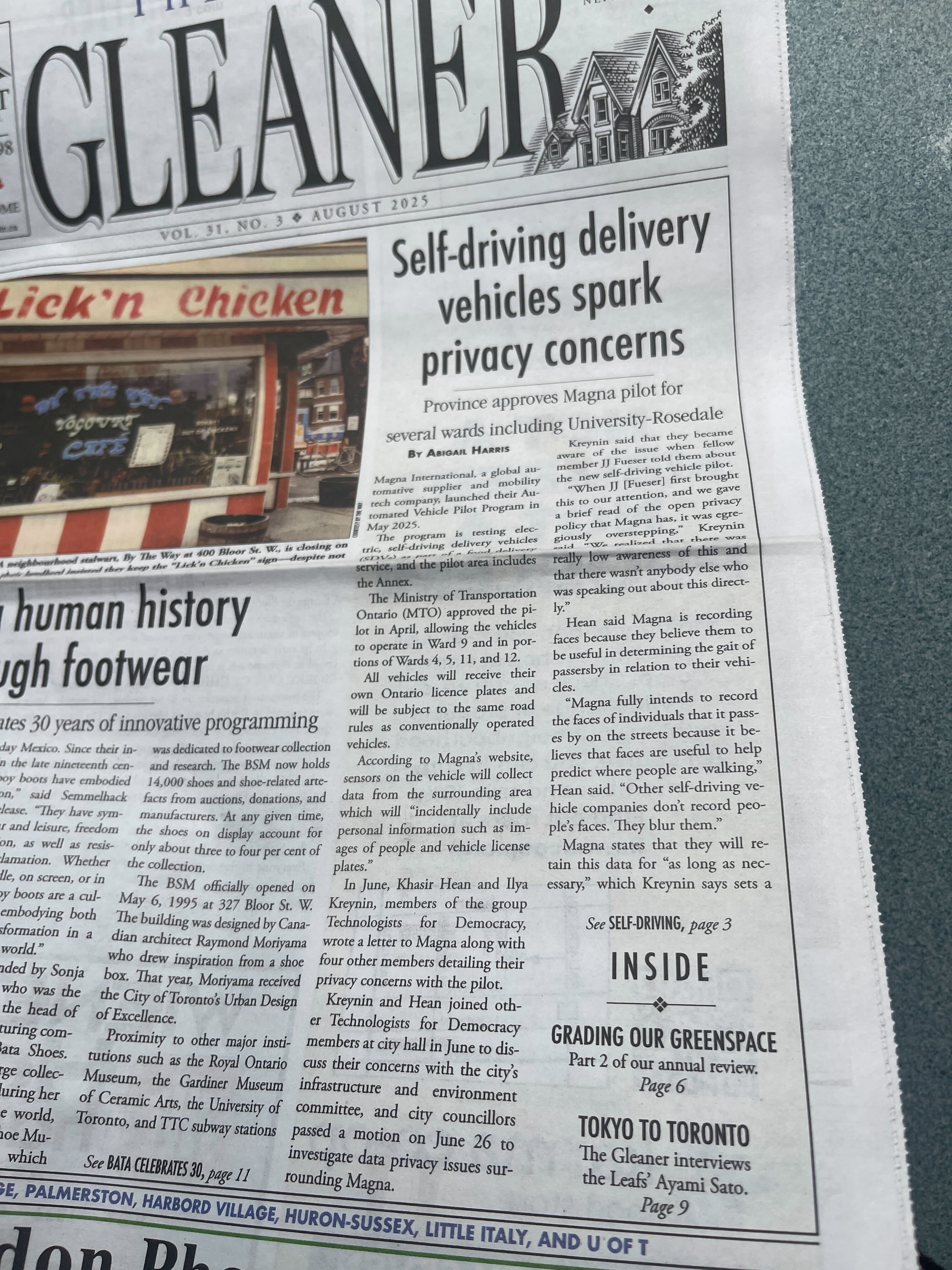
Province approves Magna pilot for several wards including University-Rosedale
By Abigail Harris
Magna International, a global automotive supplier and mobility tech company, launched their Automated Vehicle Pilot Program in May 2025.
The program is testing electric, self-driving delivery vehicles (SDVs) as part of a food delivery service, and the pilot area includes the Annex.
The Ministry of Transportation Ontario (MTO) approved the pilot in April, allowing the vehicles to operate in Ward 9 and in portions of Wards 4, 5, 11, and 12.
All vehicles will receive their own Ontario licence plates and will be subject to the same road rules as conventionally operated vehicles.
According to Magna’s website, sensors on the vehicle will collect data from the surrounding area which will “incidentally include personal information such as images of people and vehicle license plates.”
In June, Khasir Hean and Ilya Kreynin, members of the group Technologists for Democracy, wrote a letter to Magna along with four other members detailing their privacy concerns with the pilot.
Kreynin and Hean joined other Technologists for Democracy members at city hall in June to discuss their concerns with the city’s infrastructure and environment committee, and city councillors passed a motion on June 26 to investigate data privacy issues surrounding Magna.
Kreynin said that they became aware of the issue when fellow member JJ Fueser told them about the new self-driving vehicle pilot.
“When JJ (Fueser) first brought this to our attention, and we gave a brief read of the open privacy policy that Magna has, it was egregiously overstepping,” Kreynin said. “We realized that there was really low awareness of this and that there wasn’t anybody else who was speaking out about this directly.”
Hean said Magna is recording faces because they believe them to be useful in determining the gait of passersby in relation to their vehicles.
“Magna fully intends to record the faces of individuals that it passes by on the streets because it believes that faces are useful to help predict where people are walking,” Hean said. “Other self-driving vehicle companies don’t record people’s faces. They blur them.”
Magna states that they will retain this data for “as long as nec-essary,” which Kreynin says sets a dangerous precedent.
“That’s entirely vague. They can keep it however long they want,” Kreynin said. “This is a new level of privacy breach in terms of this type of storing and anonymization. This company is running their cameras and robots into our neighborhood where people did not choose and consent to this happening.”
The privacy policy also asserts that data will be shared with third parties such as insurance providers, law enforcement, and other officials when required by law.
Hean says this raises many questions about Magna’s process of sharing this information and its ethicality.
“Where’s the accountability in that?” Hean said. “How will we be informed if the police decide to use Magna as a live tracking device as well as a food delivery service? How do we and the public know this? There’s no mechanism to inform the public.”
Kreynin says Magna responded to their letter in July, not by addressing their concerns, but by inviting them to tour their facility.
[Image of a man picking up food from the Magna self-driving vehicle, with caption: Magna’s pilot program supports small-package deliveries like food, groceries, and retail items.]
“While they invited us to the facility, they have not responded to any of the clear and direct concerns laid out in the letter in writing,” Kreynin said. “We have not received any kind of satisfactory or clear response from Magna at this time.”
According to Kreynin, an important consideration in this emerging new technology is whether it is helping or hurting communities.
“The point of the vehicles is to replace workers,” Kreynin said. “This industry is only set to expand in a way that is likely to hurt local businesses and communities. The question is, what is the effect that this has on our society? This pilot is not just a pilot [of] technology; it’s a pilot of integration into our society.”
Magna International did not respond to the Gleaner’s request for an interview.
Algorithmic Pricing Needs Greater Transparency and Guardrails
Dear members of the Competition Bureau,
We are Technologists for Democracy, a grassroots advocacy organization based in Toronto. Our position largely concerns the effects of algorithmic pricing from the consumer perspective.
Most consumers – 68% – feel that dynamic pricing unfairly takes advantage of them.1 This is not necessarily because of an inherent unfairness of dynamic pricing, but because most companies operate dynamic pricing through a purely profit-oriented lens focused on the short term. There is little thought given to transparency, company trust, or consumer well-being.
Consumers are particularly vulnerable to downstream effects of algorithmic pricing, especially in markets of essential goods, markets with high barriers to entry and effective monopolies. Without reasonable alternatives, consumers become captive to price increases. Low-income consumers are particularly affected, due to any given purchase constituting a larger portion of their income. Housing is one such essential market – we welcome the Competition Bureau’s current probe into the use of algorithmic pricing for setting rental prices, and would recommend prohibiting the use of algorithmic pricing for housing (recommendation #6 below).
In addition, we believe algorithmic pricing can lead to market inefficiencies. When companies offer personalized dynamic pricing, with different prices for each individual consumer, it becomes difficult for consumers to compare and recommend prices between competitors, and difficult for competitors to efficiently set prices according to the market. We see personalized dynamic pricing as a dangerous opportunity for larger entities to unfairly exploit their market dominance by reducing the information available to their competitors.
To limit the harmful downstream outcomes of algorithmic pricing, our recommendations focus on improving transparency and guardrails surrounding algorithmic pricing. In the same way that nutrition facts labels and ingredient lists allow consumers to make informed decisions before purchasing food, labels on algorithmic pricing would allow consumers to make informed decisions before purchasing digital and digitally-enhanced products and services.
To improve transparency, we support regulation and enforcement which would require that companies clearly disclose:
Whether or not algorithmic pricing is in effect for a given product or service.
If algorithmic pricing is in effect, whether the pricing model was developed in-house or is outsourced to a third party.
If algorithmic pricing is in effect, whether or not AI/machine learning is used for algorithmic pricing, as opposed to a rule-based model.
If algorithmic pricing is in effect, what data is inputted into the pricing model. For example:
Consumer data such as location, credit score or demographic profile,
Inferred data such as consumer emotional state,
Internal data such as sales counts,
External data such as competitor prices or current weather,
Etc.
To ensure enforcement of policies, we support:
Establishing team(s) and process(es) to handle complaints and appeals for policies related to recommendations in this letter.
In addition to educational regulation, we also support investigations as to the feasibility of:
Prohibiting personalized, dynamic algorithmic pricing from being used in certain market sectors such as those of essential goods and services (including food, housing, and medication).
Regulation of prices such as through a Maximum Retail Price policy, effective in countries such as India.
We believe that these suggestions will:
Improve consumer trust of algorithmic pricing.
Inform consumers as to what personal data is involved in making a purchase.
Lower the competitive barrier to entering markets already populated with algorithmic pricing models, while still allowing companies to maintain secrecy of the inner workings of proprietary pricing models.
Reduce possible harms on consumers and competitors alike by preventing predatory pricing.
Ensure equal opportunity of access to essential goods and services for consumers.
We urge the Competition Bureau to increase transparency and implement guardrails on the use of algorithmic pricing.
Sincerely,
Khasir Hean [email removed for privacy]
Henry Wilkinson [email removed for privacy]
Jenny Zhang [email removed for privacy]
Cole Anthony Capilongo [email removed for privacy]
There are a number of concerns that we as technologists have with regards to Bill C-2:
Loss of privacy from requiring electronic service providers to provide basic subscriber information to CSIS and law enforcement agencies without a warrant.
Creation of a new term, electronic service provider, which includes social media platforms, email providers, messaging services, gaming platforms, internet service providers, and more…
Reduction of oversight over CSIS and law enforcement agencies.
Update 10/02/25: Magna is no longer operating its pilot in Toronto! Thank you to everyone for your support in making this happen. Innovation does not need to come at the cost of privacy!
Our original post is below.
On May 26, 2025, Magna International Inc. began a self-driving vehicle pilot for food delivery within the City of Toronto. Magna intends to blur license plates but record people’s faces within the vicinity of the vehicle because “Magna believes that faces are very useful to determine gaze, pose and intent of motion” according to a background report by the City.
Other companies like Real Life Robotics, which is running a self-driving vehicle pilot in Markham, aren’t recording people’s faces: “the AI software [Real Life Robotics] use can easily scrub identifying features, like faces and licence plates.”
How you can help!
On June 27, we sent a letter (read here) to Magna with a list of specific privacy concerns based on their privacy policy.
If you want to get involved with strategy and planning, sign up on our volunteer page!
Magna’s last-mile delivery device (LMDD) operating in Michigan.
On June 11, 2025, the pilot was discussed at the City of Toronto’s Infrastructure and Environment committee. The pilot is under the jurisdiction of the Province of Ontario, but Toronto is allowed to submit comments and feedback to the Province.
The pilot area in Toronto covers all of ward 9 and parts of wards 4, 5, 11 and 12.
JJ, Ilya, Khasir and Akhil spoke up about the privacy concerns surrounding the pilot. Thanks to their voices, city councillors passed a motion on June 26 to investigate data privacy issues through the following questions:
What type of data is being collected?
Who has access to this data?
Where is this data being stored?
Can or will this data cross the border into the United States?
Can Magna entities within the United States view the data?
Would Magna entities be required to provide data to US or Canadian law enforcement if requested?
Will facial recognition data be shared with law enforcement?
Can future agreements change the nature of how the data is collected, stored, transmitted, and used?
Are there any mechanisms for individuals, including those who cannot provide consent, such as children, to opt-out or request that their records be deleted?
Are there ways to ensure that data can be destroyed if no consent was given?
Can the terms and conditions of data management be changed, and if so, by whom?
Does the City’s Digital Infrastructure Strategic Framework govern the collection and use of this data and if not, what can the City do when third parties want to harvest data in the public realm?